Posts

Week 7: How The Drone Net Works - Software Pt. 1 - Code

Image
Hello Everyone! This week, I have been coordinating resources for the upcoming Drone Net tests. Because Embry-Riddle Aeronautical University is only 1/4 mile from the Prescott airport, the research team has to file a flight plan in order to fly drones on the campus. Also, we can't fly the drones while classes are in session, so the tests are quite unique, designed to quickly gather data on drone flight patterns. This week, I would like to begin a discussion of the Drone Net software. What software does Drone Net utilize? Currently, Drone Net utilizes an open-source computer vision library as the foundational library for its software. This library is called OpenCV  and the current language of the Drone Net code is C++.  Computer vision describes the ways that computers can gain an 'understanding' of digital images or videos. Let's take a minute to discuss this concept. A computer obviously does not see things as we humans see things; therefore, we must design ...
Week 6: How Drone Net Works - Hardware Pt. 2 - Mounting and Deployment

Image
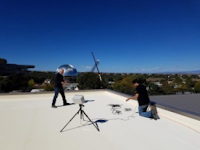
Hello Everyone! This week, I began my early spring break, but I have been able to continue analyzing previous drone net tests. This week , I would like to dive into a discussion of the Drone Net hardware: How does Drone Net's physical design affect its deployability? The Drone Net system can fit into the form factor of a medium shoe box, making extremely portable. The computer box can mount on most standard-form tripods and needs only two cables to be operated. Additionally, the drone net's weatherproof casing allows the device to remain in use during most weather conditions. First deployment of the Drone Net at ERAU Also, the Drone Net is currently designed to operate on 9.5 Watts while utilizing three cameras. By comparison, the average home computer uses 250 to 500 Watts. The low power consumption allows multiple Drone Net devices to be placed in various locations around a sensitive area. Likewise, the fact that Drone Net is fully automated saves money and t...

Week 5: How Drone Net Works - Hardware Pt. 1 - Cameras and Architecture

Image
Hello Everyone! This week, I have been reading many related research papers, continuing my study of C++ and experimental design. Because I am still learning about the advanced software engineering, the majority of my recent contributions have been in experimental design. This week , I would like to dive into a discussion of the Drone Net hardware: How is the Drone Net's camera system configured? The camera system includes a Tegra K1 SoC, wireless 802.11, Ethernet wired, USB3, a PCIe card interface, and is able to support 2 USB3 visible cameras and between one and four analog cameras including long-wave infrared.  The Drone Net operates on an open architecture. You may remember this term from earlier posts on this site. Generally, a computer is an open architecture if it is designed to allow its parts to be easily swapped out and modified. For example, an Apple iPhone is a closed architecture, because it utilizes a proprietary system to transfer data between processors ...

Week 4: How Drones Broke Airspace Security

Image
Hello Everyone! This week, I began designing range experiments to the test the limitations of the Drone Net and its software. Because I am still learning about the advanced software engineering, the majority of my recent contributions have been in experimental design. For week 4, I will answer the following questions: How do we currently secure our airspace? It might be prudent to discuss the concept of 'airspace' before anything else. Airspace is defined as any space, immediately above the surface of the earth, available for use by aerial systems, such as planes, balloons, drones, etc.  This guide describes different types of airspace and how they are defined. In order to prevent collisions between aircraft, air traffic control (ATC) operators monitor the airspace and direct air traffic around the clock. In general, the tools used by ATC are the only tools available to secure our airspace. Primary Radar (PR) is the most well-known type of radar. An ATC t...

Week 3: Drone Net Introduction

Image
Hello Everyone! This week, the research team heard back about the proposal for funds through Embry-Riddle. The project will receive 87% of the requested funding amount, distributed over the next two years. I am extraordinarily excited to hear this, because it means that the research team can initiate new experiments For week 3, I will attempt to answer the following question: What is the Drone Net? Drone Net is a name that encompasses both the hardware and software parts of a motion detection and drone identification device, currently in use at Embry-Riddle. Another name for the system is a Software-Defined MultiSpectral Imaging System (SDMSI). The full name shows that the Drone Net uses software to analyze and manipulate the output from physical hardware. The Drone Net utilizes two panchromatic (black-white) cameras and a single infrared camera. The images from all three cameras are fused together and analyzed by software in real time. The hardware components are most easil...

Week 2: The Purposes of Drones

Image
Hello Everyone! This week, Professor Siewert, the team and I are waiting to hear back about the proposal for funding through Embry-Riddle. This week, I have been learning to utilize support vector machines (SVMs) and program in the OpenComputerVision software (OpenCV). For week 2, I would like to answer the following question: What is the purpose of a drone? Drones actually have many different applications across the world. I will attempt to provide a few examples, categorize the main uses for drones and explain their relevance to Drone Net. Fully compliant : A drone pilot flies his personal drone around on public lands to film video footage of landscapes. He files a flight plan, follows all drone flight zone regulations, and his drone self reports its location using GPS.  Fully compliant : Amazon utilizes cargo drones to deliver packages to customers nearby their distribution facilities. Semi-compliant : A drone hobbyist pilots his personal drone above public la...

Week 1: All About Drones

Image
Hello Everyone! I have been working with Professor Siewert and the research team from ERAU and UC:Boulder. During this week, I have been trying to catch up with the graduate-level mathematics and software engineering knowledge required to perform experiments with the Drone Net. Initially, I wasn't sure how to approach these weekly posts, but I guess I should start my research project by asking a decent question. For week 1, I would like to answer the following: What is a drone? Now, this question is deceptively simple. The word "drone" is just slang for any unmanned aerial system. Military and commercial/recreational drone are the two main types of drones currently in production. Below, you will find two infographics that display the diversity of drone design. Military drones are typically much larger than any other type of drone. Recreational and commercial drones have generally simpler designs. In terms of design elements, recreational and commercial...